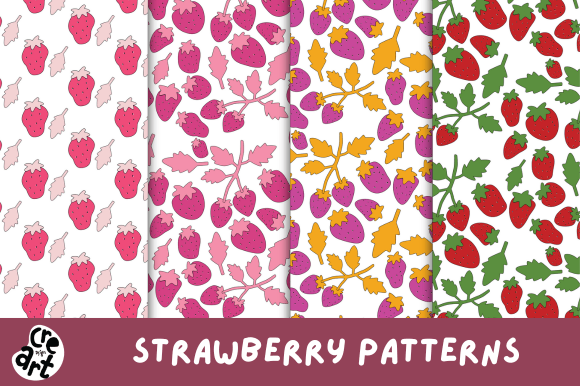
Strawberry Patterns – PNG and JPG Format: A Practical Evaluation for Designers
In the landscape of digital design assets, few motifs are as universally recognized or versatile as the strawberry. It evokes associations with summer, sweetness, freshness, and playful aesthetics. For designers, scrapbookers, and print-on-demand entrepreneurs, incorporating this motif often requires high-quality vector or raster patterns that can scale without losing integrity. This is where Strawberry Patterns – PNG and JPG Format enters the conversation as a specific resource option. Unlike open-source clip art or generic stock photos, this product offers a curated set of four distinct patterns designed specifically for both digital and physical applications.
Evaluating whether this specific pack meets your project needs requires looking beyond the visual appeal. We must consider technical specifications, file format utility, color mode compatibility, and the breadth of potential use cases. This analysis breaks down what makes this collection distinct from other pattern resources, helping you decide if it fits into your current workflow or if you should seek alternative solutions.
Understanding the Core Product Specifications
The foundation of any good design asset lies in its technical quality. Strawberry Patterns – PNG and JPG Format distinguishes itself by offering high-resolution files that cater to two very different creative workflows: screen-based design and physical printing. The pack includes four unique patterns, each rendered at a substantial 5000 x 5000 pixels. To put this in perspective, at a standard print resolution of 300 DPI (dots per inch), these images measure approximately 16.67 x 16.67 inches or 42.42 x 42.42 cm.
This dimension is significant for several reasons:
- Seamless Tiling Capability: High pixel counts ensure that when the pattern is tiled across a larger surface—such as a fabric bolt, a wallpaper roll, or a large poster—the edges remain clean and the individual strawberry elements do not appear pixelated or blurry.
- Crop Flexibility: Designers often need to crop patterns to fit specific aspect ratios. Starting with a 5000-pixel square provides ample room to adjust compositions without degrading image quality.
- Print Readiness: At 300 DPI, these files meet the industry standard for high-quality commercial printing, ensuring sharp details in final products like t-shirts, mugs, and stationery.
However, the true value proposition of this product lies in its dual-format delivery. By providing both JPG and PNG versions, the creator addresses the most common friction points in digital design workflows.
Format Comparison: JPG vs. PNG Utility
When selecting design assets, understanding the difference between JPEG and PNG formats is crucial. Strawberry Patterns – PNG and JPG Format provides both, but their intended uses differ significantly. Knowing which file to use when can save time and prevent costly errors in production.
The Case for JPG Files (CMYK)
The inclusion of JPG files in CMYK color mode is a strategic feature for this product. CMYK (Cyan, Magenta, Yellow, Key/Black) is the color model used by almost all professional printers. RGB (Red, Green, Blue) screens look vibrant, but colors shift when converted to ink. If you are designing for physical products, starting in CMYK helps predict how the final print will look more accurately than an RGB file would.
Use the JPG files when:
- You are preparing files for Print-on-Demand services like Redbubble, Society6, or Amazon Merch.
- You are sending designs to local print shops for business cards, flyers, or packaging.
- You are creating textile designs for fabrics where color accuracy is paramount.
The Case for PNG Files (RGB)
PNG (Portable Network Graphics) files support transparency and are optimized for digital displays. While the description notes these are in RGB mode, the PNG format’s ability to handle alpha channels (transparency) is often its primary advantage. However, even without transparency, PNGs offer lossless compression, meaning no quality is lost during saving and re-saving, unlike JPGs which degrade with every edit.
Use the PNG files when:
- You are designing for websites, social media banners, or email newsletters.
- You are working on digital scrapbooking projects in software like Canva or Photoshop.
- You need to overlay the pattern onto another background while maintaining crisp edges.
- You are creating mobile app backgrounds or digital wallpapers.
Comparing Against Alternatives and Market Options
Designers rarely choose assets in a vacuum. When evaluating Strawberry Patterns – PNG and JPG Format, it is helpful to compare it against other common sources of strawberry-themed graphics.
Vector Patterns (SVG/EPS)
The primary alternative to raster patterns (JPG/PNG) is vector graphics. Vectors are mathematically based and can be scaled infinitely without losing quality. If your project involves logo design or intricate cut-files for Cricut or Silhouette machines, vectors are superior. However, vectors require specialized software (like Adobe Illustrator) to edit effectively. Strawberry Patterns – PNG and JPG Format appeals to users who may not have vector editing skills or who prefer working in raster-based programs like Photoshop, Procreate, or even simpler tools like Microsoft PowerPoint. The tradeoff here is infinite scalability versus ease of access.
Generic Stock Photography
Many designers opt to download individual strawberry images from free stock photo sites and create their own patterns. While this seems cost-effective, it often leads to inconsistency in style, lighting, and color palette. A DIY approach might result in a pattern that feels disjointed. Curated packs like this one offer cohesive design language across all four patterns, ensuring a professional, unified look. The investment in a pre-made pack is often justified by the time saved in editing and aligning elements.
Low-Resolution Clip Art
Free clip art libraries are abundant, but they frequently suffer from low DPI (often 72 DPI) and small dimensions. Using such assets for print results in blurry, pixelated outputs. The 300 DPI specification of this product directly addresses this limitation, making it suitable for commercial-grade work where low-res alternatives would fail.
Best-Fit Use Cases and Applications
To determine if this resource is right for you, consider where you intend to deploy these designs. The versatility of Strawberry Patterns – PNG and JPG Format allows it to span multiple industries and hobbies.
Print-on-Demand and E-Commerce
This is perhaps the strongest use case. Entrepreneurs selling on platforms like Etsy or Shopify can use these patterns for:
- Apparel: T-shirts, hoodies, and tote bags benefit from the playful, bold nature of strawberry prints.
- Home Decor: Pillowcases, duvet covers, and curtains can utilize the seamless tiling capability for a cohesive bedroom aesthetic.
- Stationery: Notebooks, planners, and greeting cards see high demand for cute, seasonal themes.
Digital Content Creation
Content creators and bloggers can leverage the RGB PNG files to enhance their visual identity. These patterns work well as:
- Website headers and footer backgrounds.
- Social media story templates (Instagram, TikTok).
- Email marketing campaign backgrounds.
- YouTube channel art.
Personal and Educational Projects
For teachers, parents, and hobbyists, these patterns are ideal for:
- Classroom decorations and bulletin boards.
- Party invitations and thank-you cards.
- Scrapbooking memories from summer events.
- DIY craft projects, such as customizing phone cases or water bottles.
Limitations and Considerations
No product is perfect, and understanding the limitations helps manage expectations. Since these are raster images (pixels) rather than vectors, they cannot be easily recolored or reshaped without affecting quality. If you need to change the color of a single strawberry from red to pink, you would need advanced editing skills and may introduce artifacts.
Additionally, while the CMYK JPG files are print-ready, professional printers may still request PDF/X-1a formats or specific bleed settings. Designers should always check the specific requirements of their printing vendor before uploading. Furthermore, the "fresh" and "fun" aesthetic, while appealing to many, may not suit minimalist, corporate, or somber design contexts. It is best suited for brands and projects aiming for a cheerful, youthful, or summery vibe.
Final Verdict: Is It the Right Choice?
Choosing Strawberry Patterns – PNG and JPG Format depends largely on your technical comfort level and output medium. If you are a designer who works primarily in raster software, needs immediate print-ready CMYK files, and wants a cohesive, high-resolution set of summer-themed graphics, this pack offers excellent value. The dual-format inclusion solves the common headache of converting between screen and print modes manually.
Conversely, if you require infinite scalability for large-scale billboards or need to manipulate individual vector shapes for complex illustrations, you might find better utility in SVG-based assets. Similarly, if your budget is zero and you have unlimited time, sourcing individual elements and building your own pattern might be preferable, though it sacrifices consistency.
Ultimately, this product serves as a robust tool for creatives looking to add a burst of color and playfulness to their work. Its strength lies in its readiness for both digital and physical realms, bridging the gap between online branding and tangible merchandise. For those seeking a reliable, high-quality foundation for strawberry-themed designs, this collection stands out as a practical and visually engaging option.